
Reproduction Parts for 1916-1964 Chevrolet Passenger Cars & 1918-1987 Chevrolet & GMC Trucks SHOP ONLINE | ONLINE CATALOG | ABOUT US

So, I had a feeling the wood under the cab at the cowl was bad. Everywhere I can see wood it looks great. There were some tell tale signs on the cowl that there was a problem. I removed the fenders, running boards and slash apron for painting and the wood at the front of the cab is badly rotted on the passenger side. Today, I removed those same parts from the driver’s side and its not as bad but I would rather replace it now than deal with it in the future… I also don't like passing problems on to future owners.
I have good wood working skills and my FIL is a master woodworker. I am sure we can figure out how to duplicate what is there if necessary. I do have a call into Classic Wood to see if I can buy them but I know they are very backed up.
I have removed all the body mount bolts and the entire interior. I plan to take the doors off to reduce the weight when lifting the body. I have never done work like this on a wood framed car. I assume the wood comes out the bottom once I release all the nails and floorboards. I plan to brace the doors and cowl with angle iron and 2x4s to prevent shifting during the process.
Here are my questions if anyone has done this before… (before anyone asks, yes I have measured everything. Door openings in multiple places, cowl measurement and today I am going to take some more measurements cross body to make sure everything stays where it is supposed to)
1. I assume the wood will come out the bottom when the body is lifted. Is there a trick to this? I can see screws from the A pillar to the sill wood. B pillar is likely the same.
2. The metal on the cowl is rotting as well. I know I can fix that but welding metal over wood is not ideal. Is there an another better way to install patch panels on these cars?
3. I plan to install cross bracing in the interior of the cowl and also some bracing from the firewall to the A pillar and then the A pillar to the B pillar. Is this sufficient or should I also have cross bracing from the left to right B pillar?
4. What is the best way to lift the body… if that’s is how best to remove the offending wood?
5. I also assume the doors need to come off to make this easier. Is that correct?
Sorry I ask such a noob. I am very anxious about doing this. I have done work like this on metal cars… those are easy. This one confounds me and I just don’t want to damage anything. This car didn't survive 96 years for me to mess it up now.
Thanks
Rich

Some pictures of the damaged wood might help with the answer. How are the bottom ends of the hinge and latch pillars? I have done /doing a couple of convertibles and I suspect they are easy compared to a closed car. I just don't know how you do it without taking the metal all off unless it is minor rot damage. I do have a pair of 29 front hinge pillars I will never use if you end up needing them.
Dave
@david-dunton Dave, Thanks for the quick response. The hinge post (what I refer to as the A pillar) looks good except for the lowest part which is a bit punky but Zi think I can remedy that. The sill that goes from the cowl to the rear wheel well is rotted at the front. My primary question is how to remove the old wood. Does it come out the bottom? Or does it come out through the interior of the car? Also how to patch the metal? I dont think welding patch panels in over wood is a good idea… but then again I have never tried it. 😁
attached are pics of the sill by the cowl (from under the car) and the door post (form inside the car). I think the door post is fixable. The sill is not. I need to get it out and replace it. The other side is bad too but not this bad.
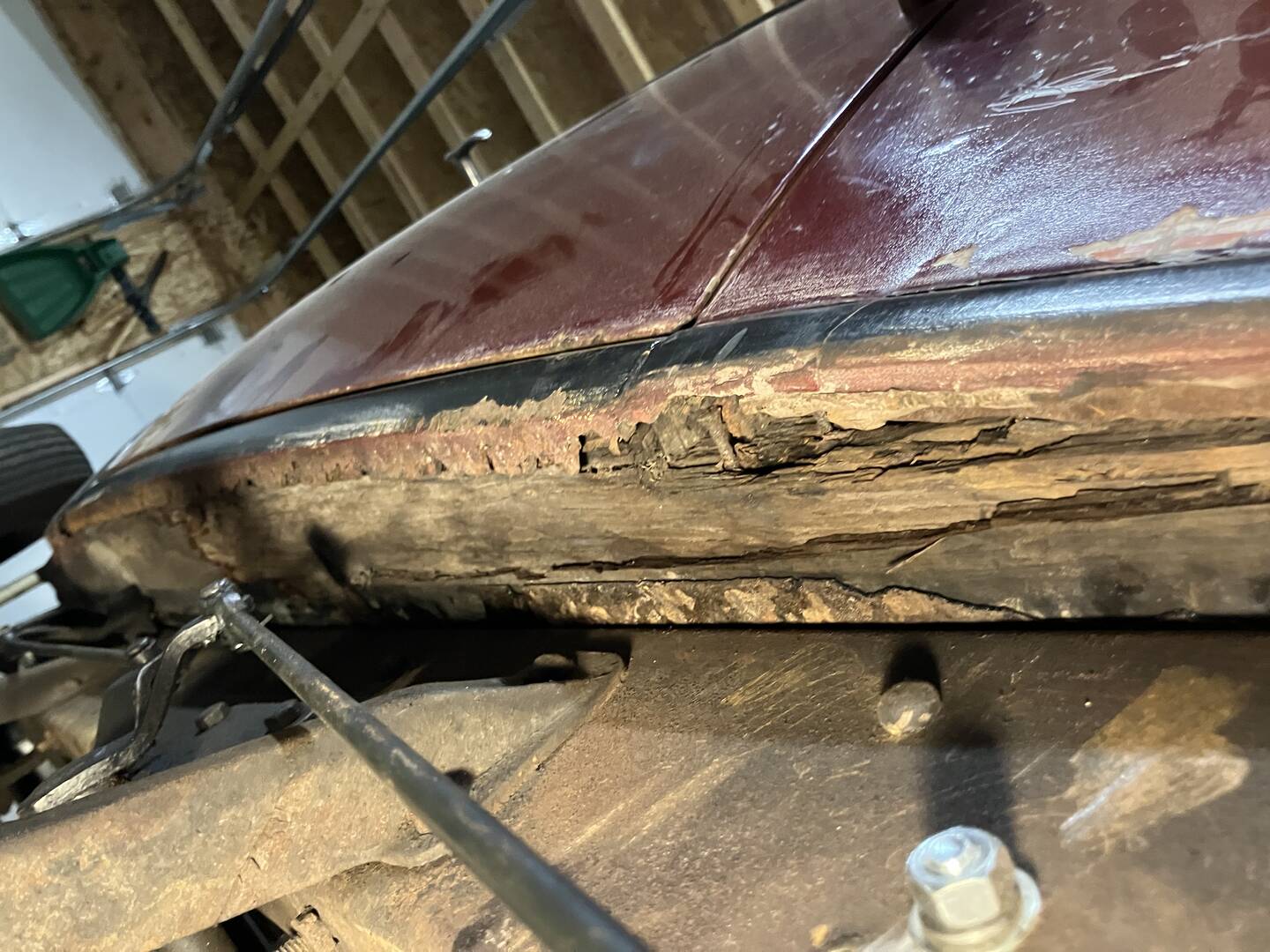
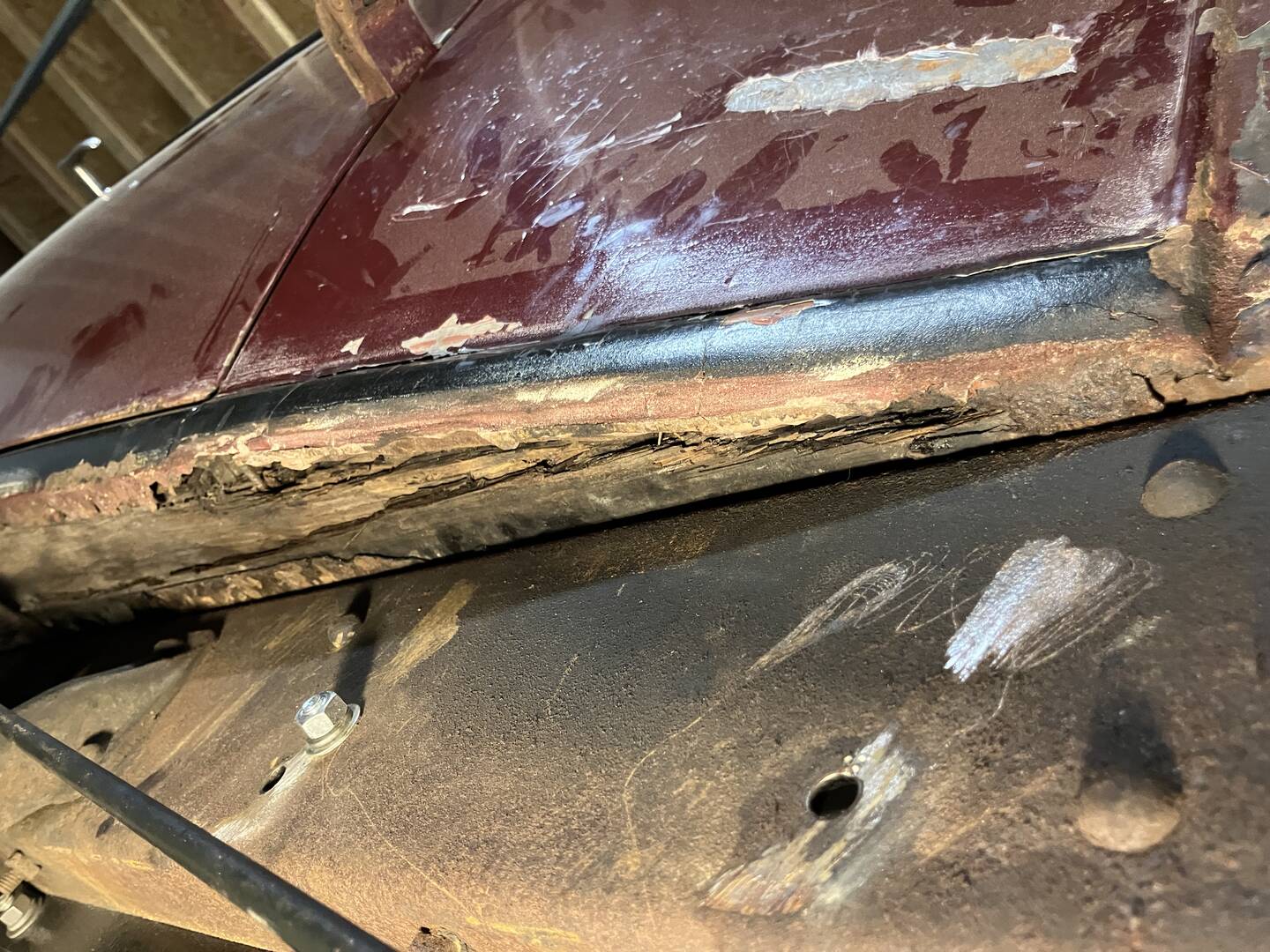
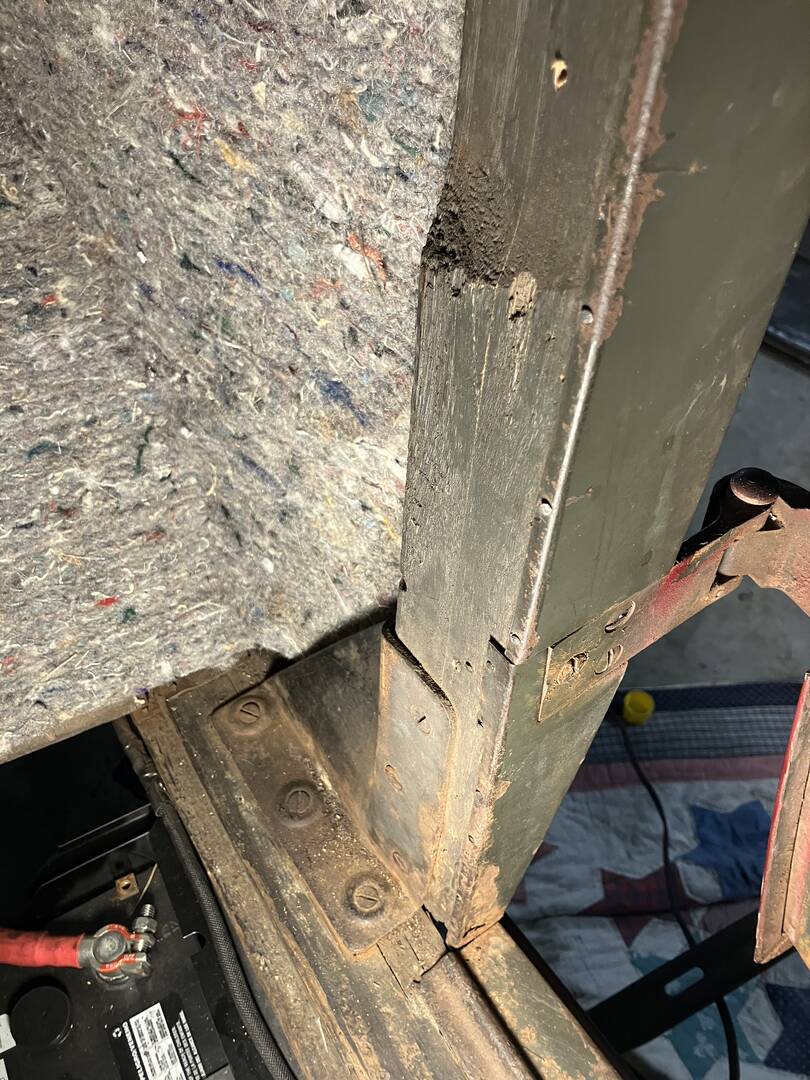

The body is lifted off the frame after removing all attaching screws and brackets. Both the sills on my 32 were replaced though I did not do the work. On my car the body was removed completely but I am guessing the sill could be replaced if the body was lifted just enough to slide the sills out. My thoughts are that it best to replace one side first while leaving the other side in place. Also you might want to get a copy of the Fisher Body Service Manual for 26-31 . I think The Filling Station should have them. Item #100536C
7472 old site post
@steve-d thanks Steve, I was thinking the same thing, one side at a time. I will be removing the doors today and installing more bracing than I probably need. But better safe than sorry. I will get the manual as well.
I suppose you could replace the sills from the bottom. All body nails, pillar brackets and cross braces where the tool tray and metal flooring is nailed would have to be removed where they are attached to the sill. I have just re-wooded by removing all the metal but all my wood was bad. Welding after the metal was off.
Please post pictures of your work this will be good to see. Also check the top front roof area for rot where the hinge pillar meets the roof and windshield.
Dave
@david-dunton Dave, I will post pics as I restore this car. Right now I’m waiting for some materials so paint stripping is the job this week.

Hello Stovebolt 6,
Check out AACA forum topic discussion 'removing a body off the frame', some opinions concerning wood framed bodies. To your questions: #1. After body to chassis bolts are removed and verifying sills are not stuck to chassis, when lifting body the sills will come up with the body. Then you remove all fasteners attached to sills. Pillars are glued and screwed. #2. With sills removed, do the sheet metal repair. Use heat shielding as necessary. #3. The more bracing the better. Cross bracing too. #4. Artificial Intelligence has a checklist for this. Say what you have, what you are doing, ask how best to lift body. Interior bracing to upper coachwork headers and slings are apart of the procedure. #5. Remove doors and put X-bracing in the openings. Hope these thoughts are of help. With regards to rotted sills: Custom made or home made, mock-up and fitment may require work. Having pictures and measurements and a template of the old sills would be good to have.
@harry-truppner Thanks Harry, I have removed the doors and part of the floor. I will check out the sources you mention. Bracing is critical. I want to be sure nothing moves. I already have a dozen+ measurements and several diagrams (and will take lots of pictures) Whether it’s goes great or tragically it may help someone in the future.
I plan to get some maple if I can’t get ash. I will also get some dimensional lumber to make a template. I can’t afford to make a mistake on the hard wood. Once I get the sill out I will piece it together and cut a template from cheap lumber. Once that fits good I can cut the expensive stuff.
I was figuring on doing the metal repair once the wood is out and using copper flashing as a heat sink. I am a bit apprehensive about doing this but I am pecking away at it while I also strip the car to bare metal as the current paint is chipping.
Thanks Again
Rich
@stovebolt-6 I do not recommend maple for the sills. I suggest you use white oak. The sills are usually made up of two pieces laminated together.
7472 old site post
Here’s a hare brained idea. It may be sacrilege but the more I research and look at my sill situation the more I feel like this is not a doable job with my skills and equipment. I am a one man operation. In order to brace and lift this body to expose the sills and remove them will require a great deal of luck. I can’t see a way to remove the sills from the bottom with all of the sheet metal curled under it and the heavy board where the seats bolts in is tenoned into the sills on both sides. I may be able to figure a way to lift the body leaving the sills exposed. I may be able to get the old sills out by cutting them up but installing new “whole” sills with the metal and those tenons in place seems impossible.
I suppose I could cut the tenons and then replace it with a spline or dowels. Then If I cut the sheet metal back I might get a “whole” sill back in. Then I have to repair the sheet metal. Tacking metal over the wood is tricky but If i can put a heat shield, like copper flashing behind the sheet metal it might work.
Or this…The sills are solid about 2/3 of the way down the door opening. I know this is structural but the sills sit on the frame. It’s not like it is supported on each end and stressed in the middle. What if I remove the rotted front part and splice in new wood in the front. I could dowel them together with hardwood dowels and epoxy and then reinforce the joint with steel plates routed into the top and bottom extending past the joint 10 to 12 inches in each direction. I still may have to cut the steel away, but it would only be the cowl… the rocker is relatively easy to remove.
I don't want to Mickey Mouse this but removing the entire sill has a high probability of failure from my perspective. I need to think on this more. I also need to remove more parts tomorrow. If I am to lift this body it will be a light and unattached as Sister Bertrille. (Forgive the 1960s sitcom reference) And I want a little as possible in the way.
Thoughts on this? Don’t be too harsh… I am really trying ot figure out the best way to make this work.
@stovebolt-6 As mentioned above the sills are laminated . I think if you offset the joints and use a good glue no plating will be needed. Doweling the butted joints sounds good to me. If you are a VCCA member you could check with the tech advisor for your car or other early tech advisors who have experience doing the job you are considering. I looked for photos for when I did mine but don't have any of removing or installing the body.
7472 old site post
There have been posts in the past, probably on the old site, about this type of repair, I believe there is some illustrations in the service manual or fisher body manual on how to scarf new wood in for a repair. It would also be good to get advice from Ted Brito who has posted here and the AACA site as he has done a lot of this type of work. He goes by @christech on the AACA site. Just curious do you have a coach or four door sedan? I would search the old site and the AACA site, Our cars and restoration projects section. I know I have seen good pictures and explanations on this somewhere in the past.
Dave
Hello Stovebolt 6,
"What if I remove the rotted front part and splice in new wood in the front." I like it. Make the splice long enough for maximum strength. Epoxied and dowelled should work ok and make for a good repair. Do you think that you can lift the body, one side at a time just enough to do the jobs? Bracing is still a key part of the work.