
Reproduction Parts for 1916-1964 Chevrolet Passenger Cars & 1918-1987 Chevrolet & GMC Trucks SHOP ONLINE | ONLINE CATALOG | ABOUT US

I received the last part needed to get the new tank installed in my 41 Chevy Coupe. As I was putting it together, filler tube, sending unit and fuel line adapters, I thought of something that might be worth doing while there's room under there before installing? In a parts cache I received with my 41 sedan, I got 3 or 4 six volt fuel pumps. One of them was a new old stock Mallory, I think. I've read quite a bit of the benefits and issues most comments were positive. I would only use one as a primer to alleviate the need to crank and crank to get it running. It would be used with a manual switch.
What I don't know is whether all or any of them will flow fuel through them using only the mechanical pump once the switch for power is turned off. I also bought a new in-line 6 volt pump a while back and could use it if I find the mounting method more convenient.
Any thoughts...suggestions?

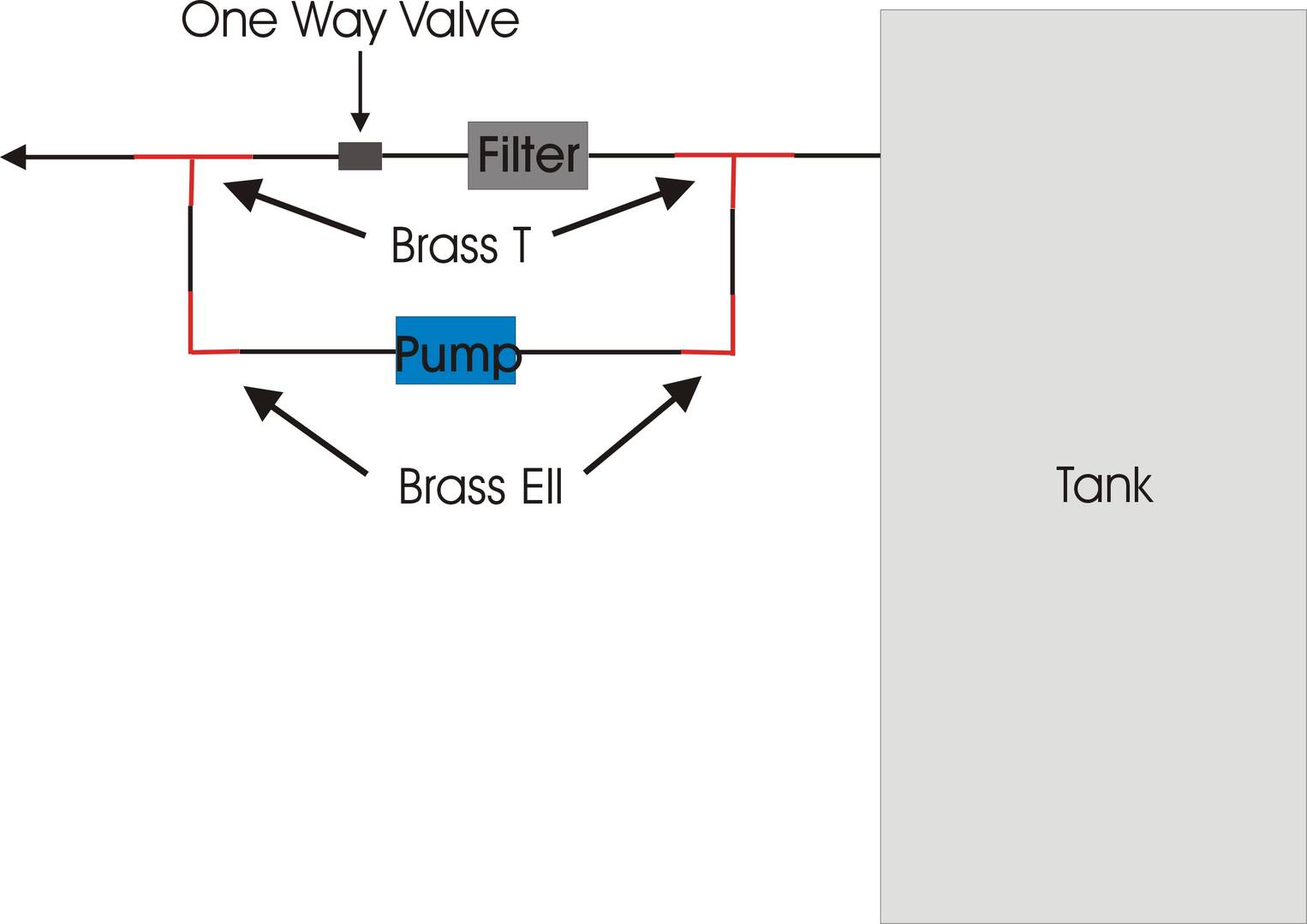
A lot of folks recommend installing an electric priming pump in series so that the mechanical pump pulls fuel through the electric pump when the electric isn't running. There's a cautionary side of the recommendation. Blow through the electric pump to see if fuel will pass easily. I put an electric priming pump on my 53. My intent was to plum it in series like everyone recommends. When I blew through it, there was WAY more resistance than I was comfortable with. I didn't want my mechanical pump to have to work that hard so I used a one-way valve and plumbed it in a bypass fuel circuit. When I activate the pump, it pushes the fuel through the mechanical pump to the carburetor. The one-way valve keeps the fuel from going back to the tank. When the electric pump is off, the fuel takes the path of least resistance and bypasses the electric pump. I started with one of the pulse type pumps that pumps with a rapid diaphragm action (silver canister with intake on one end and outlet on the other). After converting to 12 volts I updated to a Carter 12v rotary vane pump. The plumbing schematic diagram Carter includes with their pump is the same that I came up with so there must be something to it. My diagram is below.
7046 old site posts
Save a life, adopt a senior shelter pet
There are many good people. If you can't find one, be one.
1938 Master Business Coupe-Sold, now living in New Jersey
1953 210 Sedan

In the category of “while I’m under there” here’s another thing to consider if you haven’t already. Original cars had a one piece steel fuel line from the tank to the fuel pump that also provided a good ground path for the tank body, and in turn, the sending unit case. This was important because the tank straps had the insulating anti squeak material as well. Without this ground path the fuel gauge may not work or be erratic. If your new fuel line is going to to have rubber sections, consider installing a ground wire from one of the sending unit mounting screws to a good clean connection on the frame. Mike

That was one of the first things that I did when I got my truck was to run a ground strap from the sending unit to frame.
@tiny Tiny, what prompted you to change to 12 Volts on the car. My 41 Special Deluxe has been doing well electrically for a couple years on the 6 volts. Seems like a lot of work for little gain, but I don't have your years and years of experience with the issue.
The comments you all added are certainly good suggestions. When I took the tank off, I noticed there was no ground lug on it, but the new one does. The issue of putting a rubber splice in the line would definitely cause a lacking of grounding issue. I'll take care of that for sure.
@tiny I bought a 6 volt fuel pump and prepared it per a similar diagram as you offered. I didn't install it and won't until I get the car street worthy. Several of my car friends have lifts that would make that task much easier so I will wait for a while.
@tiny Tiny, what prompted you to change to 12 Volts on the car.
Unlike my 38, the 53 isn't a valuable car worth keeping stock, preserving it's history. While the 53 is low mileage, it's life was not one of gentle treatment. It's strictly a driver. It was basically a decision based on cost and convenience. I was going to put an alternator on it and 12v alternators are cheaper, 12v bulbs are plentiful and easy to find and I put a modern 12v stereo that looks like the original unit, they only come in 12v. I left the 6v starter but put a 12v solenoid on it. She cranks strong.
7046 old site posts
Save a life, adopt a senior shelter pet
There are many good people. If you can't find one, be one.
1938 Master Business Coupe-Sold, now living in New Jersey
1953 210 Sedan

@jerry-berry @tiny @dunfire @michael-falise Jerry, Tiny, Patrick, Mike, First...HAPPY NEW YEAR to one and all.
For what it is worth, I do not have electric fuel pumps on any of my old vehicles. Furthermore, I don't convert anything to 12 volts. I keep the charging systems in proper working order and my 1935 Standard Coupe and my 1936 1-1/2 ton truck seem to start whenever I ask them to. My mechanical fuel pumps are rebuilt with modern parts suitable for fuel with alcohol. When they set for a while, it takes a bit to get fuel into the carb bowl. My system is to crank for a few seconds to get some fuel in the carb, before I pump the accelerator pedal. To me, a 12 volt conversion is treating the symptoms instead of treating the illness.
Just my 2 cents worth.
Mike
Many Miles of Happy Motoring
3469 Posts on Old VCCA Chat
@35mike My electric on the 53 is a priming pump. I run on the mechanical pump.
7046 old site posts
Save a life, adopt a senior shelter pet
There are many good people. If you can't find one, be one.
1938 Master Business Coupe-Sold, now living in New Jersey
1953 210 Sedan
Mike and I are on the same page about fuel pumps and 6V systems, I previously had a 1922 American LaFrance fire engine that was 6v, and although I usually started it by hand, the 6 volt battery would sling the 855 cu in six around enough to start it. I had monster cables on it and every connection was cleaned every year. For the 1936 GMC, if it sits longer than a week, I usually squirt about 5cc's of gas into the carb with hypodermic which is enough to fire the engine and get the mechanical pump in action.
Happy New Year to all as well. Like Patrick and Mike, none of my 6 volt vehicles have been converted to 12 volts and all have stock mechanical fuel pumps. My experience is very similar, they all crank very well and start fine without priming, even after sitting for weeks. As I’ve mentioned previously, those with glass bowl filters immediately ahead of the carburetor seem to crank for a shorter duration than those without.
@michael-falise I hadn't thought about the glass filter. My 41 Coupe has a Carter W1 carb with a glass fuel filter attached to the carb. The filter should hold enough fuel to start if the carb immediately. Since this one is not road worthy because of the brakes, I can't figure if it will even need a prime to start more quickly. I'm prepared though, to install an electric fuel pump for priming but it might be a good back up if the mechanical pump should fail.
@jerry-berry I recommend using an old style mechanical pump that can be rebuilt with modern parts (diaphragm), rather that the possibly crappy, sealed, Made in China, ones that you can buy at your local supplier. I carry a rebuild kit with me when I go on tours, but I have almost no fear that I will ever need it.
Mike
Many Miles of Happy Motoring
3469 Posts on Old VCCA Chat
@35mike Mike, I literally laughed out loud with your comment about carrying a fuel pump rebuild kit with you. I did drive from Paris, TN to Tupelo, MS about 350 miles round trip in my 54 Belair, but it had only 38K miles on it. I can't tell you how satisfying that was. My 55 has been sitting a while while I'm tinkering with these 84 year old cars (same age as me). I'm hoping my two 41 Chevys will be equally as reliable.

Your plumbing diagram for the electric fuel pump bypass shows that the fuel that goes through the electric pump doesn't go through the filter. I am wondering why you didn't put the filter before the tee to the electric pump...or am I misinterpreting the situation.
Nick Gurin
Taos, New Mexico
1940 KC 1/2 Ton Pickup