
Reproduction Parts for 1916-1964 Chevrolet Passenger Cars & 1918-1987 Chevrolet & GMC Trucks SHOP ONLINE | ONLINE CATALOG | ABOUT US

Does anyone know the specifics of getting a vane pump from a 29 to fit into a 28. I know the castings are similar and I think the vanes are as well other than I think I read that later in 29 they added a second spring between the vanes.
I am asking because I know where there is an NOS 29 pump and I may consider it if I knew what it would take. I don't think I want to go the whole gear pump route out of a newer motor and I don't think I am quite comfortable with my old pump. It cleaned up nice but there is more wear than I like in the pump housing where the vanes run.
David

I believe that around 1937 Chevrolet stopped selling replacement vane pumps, and started selling the gear-type oil pumps (based on the 1937 model) as factory-sanctioned replacement pumps for the 4 bangers.
In my 4 cylinder parts book, the same pump assembly (part number 360954) was used for 1927 and 1928.
In my 6 cylinder parts book, the pump for 1929 (part number 473730) was also used for 1930, 1931, and 1932.
For both of my trucks, I didn't trust the vane pumps so I replaced them both with the gear-type pumps that are sold nowadays.
One of the reasons for my distrust was that every now and then the vane-type pump would lose its prime. To prime the pump, I would disconnect the oil tube that goes to the oil pressure gauge (disconnect at the oil distributor end only) and squirt some oil into the top of the oil distributor. After reconnecting the oil tube, the pump would start working again. Major pain in the neck.
Just to be clear, the vane pumps might lose their prime while the truck sat at home for a couple of weeks, but also sometimes if I stopped for a while (on a drive), let's say for lunch, the oil pump would lose its prime during that non-running time.
The gear-type pumps never lose their prime because they sit lower into the sump.
Cheers, Dean
Dean "Rustoholic" Meltz
San Leandro, CA
3511 posts on vccachat.org
Lurch -1927 LM one ton truck - tinyurl.com/Lurch-VCCACHAT-Gallery
Justin - 1928 AB Canopy Express (1/2 ton truck) - tinyurl.com/Justin-Stovebolt-Gallery

I will need to check to be sure. Thinking that one has a slot and the other a tab that would fit into a slot. I made a shaft that I can chuck into my battery drill and has a slot on one end and a tab on the other.
How sweet the roar of a Chevy four
Participant on Chatter since 11/22/2001
19758 posts on the former Chatter site
In Ray Holland's "School is in Session" document (starting on page 72) is a discussion about the vane pump versus the gear pump.
Here's what he had to say at the beginning of the discussion:
Vane pumps are noted for volume and not pressure. Although the ‘28 OE pump is normally satisfactory it was my desire to see if improvements could be made. My objective was to go to a gear pump and overcome the sometimes failure of the vane pump to stay primed and provide more pressure and volume.
He modified a gear-type pump that came from his stash of parts. Unfortunately, he doesn't mention what year engine that pump was originally made for.
Does anyone know?
Dean
Dean "Rustoholic" Meltz
San Leandro, CA
3511 posts on vccachat.org
Lurch -1927 LM one ton truck - tinyurl.com/Lurch-VCCACHAT-Gallery
Justin - 1928 AB Canopy Express (1/2 ton truck) - tinyurl.com/Justin-Stovebolt-Gallery

I believe you are right on.
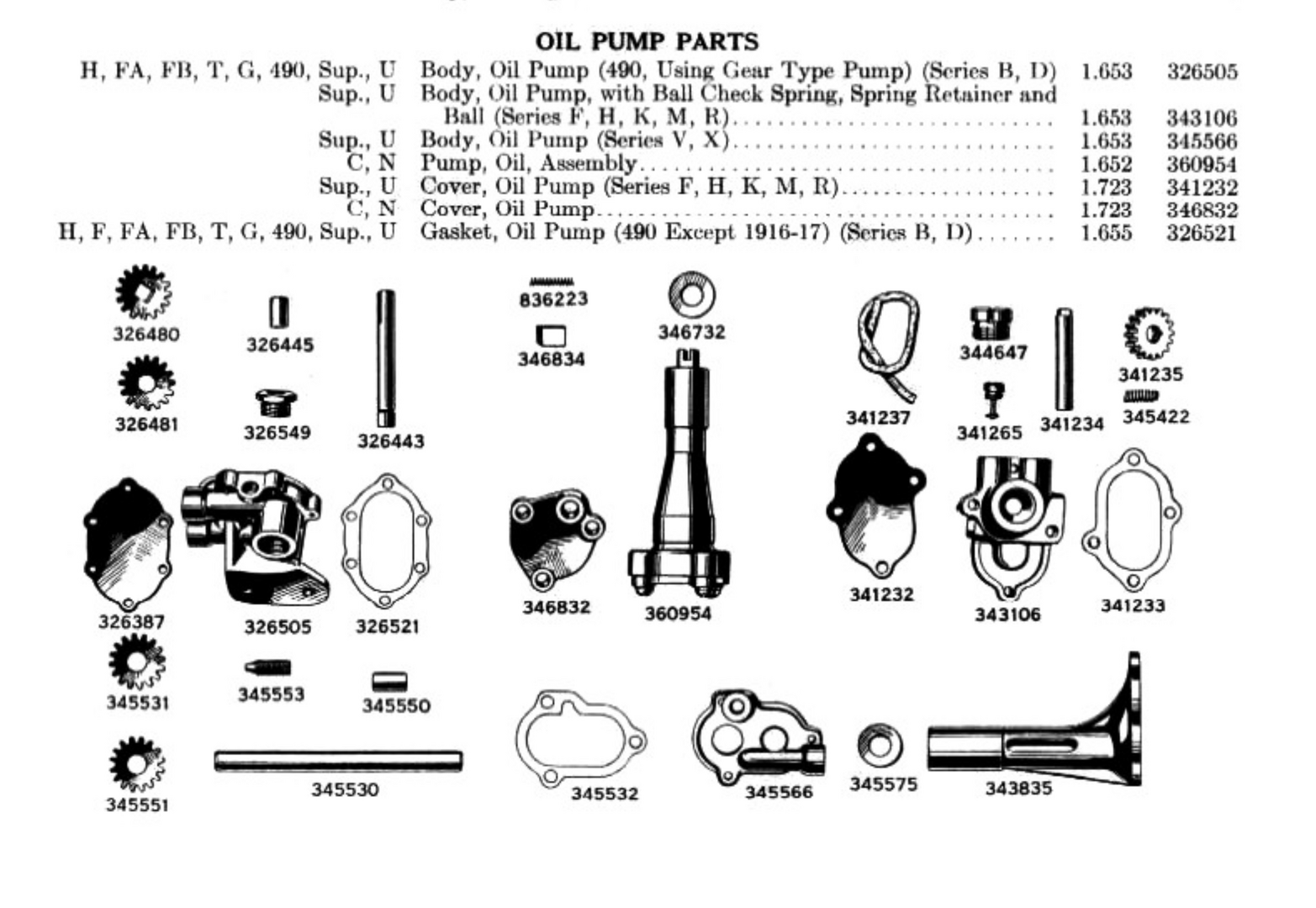
The below illustration from a parts book effective 1940 and found here:
https://chevy.oldcarmanualproject.com/parts/1916_28/cp4cm08.htm
the 4 cylinder pump had a slot, whereas my 1929 pump has a tang.
It also appears that by 1940 Chevrolet only supplied a replacement gear pump for the 4 cylinders, and parts for such.
Ole S Olson
Saskatoon, Sask, Canada
1946 DR 3/4 ton stake
1139 old site posts
Hi Dean
I've lost the direct link to Ray Holland's "School is in Session" and can't seen to find the document.
Could you supply that link please?
Thanks.
Ole S Olson
Saskatoon, Sask, Canada
1946 DR 3/4 ton stake
1139 old site posts
@ole-olson Ole, Thanks for the verification on what I remembered. Advancing Maturity sometimes is not completely accurate.
How sweet the roar of a Chevy four
Participant on Chatter since 11/22/2001
19758 posts on the former Chatter site
The PDF of the document is located in the club member only resources area of the main web page (vcca.org).
- Go to the Resources pulldown menu, Click on FORMS - Downloadable,
- Then click on Technical-Vehicle-Resources,
- Then click on 1912-1928.
- Look down the list of documents and Ray Holland's document is labeled 1928_Engine_Rebuild_Class. You can read it online or download it.
Cheers, Dean
Dean "Rustoholic" Meltz
San Leandro, CA
3511 posts on vccachat.org
Lurch -1927 LM one ton truck - tinyurl.com/Lurch-VCCACHAT-Gallery
Justin - 1928 AB Canopy Express (1/2 ton truck) - tinyurl.com/Justin-Stovebolt-Gallery
Got it!
Thanks!
You revealed something I had missed.
Apparently I missed renewing my membership, which I hadn't caught as I still had access to the online G&D and never got a notification to renew, which I thought I had in the past. Hmmmm?
Anyway, rectified.
Thanks again!
(Speaking of advancing maturity...) 🙂
Ole S Olson
Saskatoon, Sask, Canada
1946 DR 3/4 ton stake
1139 old site posts
Dean,
It's my understanding from the reading (and re-reading) and finding some clues in other threads where Ray posted that the pump came from a 1936 model and was specifically a 604510 and I believe this was an aftermarket kit number and not a Chevrolet part number. For the life of me right now I cannot remember what the pros to using that one was. I would have to go back and read and search again, but it may have to do with the way the screen pick-up is mounted being hung from the pump verses being somehow attached to the bearing cap.
If I am reading right the gear pumps that were out there for a number of years were all aftermarket as a vane pump was original equipment.
And then there was also the following said by Ray;
"Your posts of Nov 18, 2002, 19:16 and Nov 19, 2002, 16:25. All of the data you have
posted is extremely informative. That is an excellent summary of the original oil pumps
and the updating of all the early vane pumps by a gear pump. Obviously, Chevrolet felt the
gear type pump was superior to the original vane type. The 64-dollar question: Why did I
choose a ’36 pump? Because that one was in stock. Any gear pump of the period would
have been acceptable. In my application, either the entire shaft could have been replaced
or since I did not have a piece of round stock of the proper size on hand it was easier to
cut, thread and extend."
So any gear pump could work? I wonder what one's Billy Possum used?
I guess my whole point in starting this thread was to explore options and weigh pros and cons. It is becoming clearer that even if one had a NOS vane pump the possibility of losing prime is still there. Which Chevrolet realized and why the gear pumps came into play. What losing prime looks like and what the repercussions are I can't attest to as I don't yet have my engine running. Dean's explanation of what he had to do to reprime doesn't yet add up in my brain, but I maybe should re-read it a dozen more times and it might 🙃
I'm trying to stay reasonable with this whole project (which I am probably beyond anyway) and as mentioned someone had a NOS 29 pump so I was considering it. There are also several NOS gear pump kits on e-bay of various years (pump and screen) for a decent price. A several hundred-dollar kit however from parts house (that's if they even have them) isn't an option I would be excited about!
One other thing I want to note. I have read and would have to find the posts again that a solution to loosing prime is to run with an extra quart of oil in the engine????
Thanks for the input!
David
I suspect adding an extra quart of oil would not prevent a vane pump from losing its prime.
When the engine is not running (with a vane pump), I'm guessing that the 'prime' (oil around the vanes) drips by gravity back into the sump through the intake tube. There is no check valve in these pumps to prevent the oil from draining out of the 'pump chamber'. Therefore, it's the dry vanes that cause the pump to lose its prime (no suction capability).
The gear pumps have a couple of things going for them:
- The intake to a gear pump sits lower into the sump versus a vane pump.
- There is a ball check valve in the body of the pump that keeps oil around the gears when the engine is not running.
The other advantages are higher oil flow and higher oil pressure.
With the gear pumps, my engines' cold start produces oil pressure around 15-18 psi. When they warm up, that pressure drops to around 5 psi, but it stays there even when the engine gets hot.
The old vane pumps cold start put out 5-10 psi, but when the engine gets warm, it dropped down to 2 psi. That was too low for my comfort.
Cheers, Dean
Dean "Rustoholic" Meltz
San Leandro, CA
3511 posts on vccachat.org
Lurch -1927 LM one ton truck - tinyurl.com/Lurch-VCCACHAT-Gallery
Justin - 1928 AB Canopy Express (1/2 ton truck) - tinyurl.com/Justin-Stovebolt-Gallery

For my engines I went a different route. I had a picture of a 1928 oil pump, and a 1929 oil pump sitting side by side. The size of the impellers are the same from 1928, and 1929. The 29 oil pump casting size was a hold over from the 28 casting with slight changes to the distributor connection. By adding 2 more cylinders, and an oil supply to the valve rockers they increased the demand but didn't really increase the supply (engine speed rating was increased by 200 rpms). I am not sure which parts manual Dean was looking at but the oil pumps for the 1930 to 1932 engines had an impeller that was 1/8" deeper. He is very good with the parts book references. Essentially a 25% increase in volume. The 1930 to 1932 oil pump is the one I like to use in my 29s. I plan on modifying one to install in the 28 project I am slowly working on.
There are other modifications needed if you are going to install a gear pump, or anything with higher volume discharge. The biggest being to upgrade the size of the outlet into the block. Originally that fitting is 1/8" pipe and has a 1/8" pipe to 5/16" pipe to copper tube adapter. It's a tiny little thing. The installation of a Billy Possum gear style oil pump requires that the block be drilled and re-tapped to a 1/4" pipe thread so that a 1/4" pipe by 3/8" copper tube adapter be installed to handle the increased volume and pressure.