Reproduction Parts for 1916-1964 Chevrolet Passenger Cars & 1918-1987 Chevrolet & GMC Trucks SHOP ONLINE | ONLINE CATALOG | ABOUT US

My 51 has 2 keys. One operates the two doors and the ignition and the other operates the trunk I suspect that the door locks are worn because I have a very hard time locking and unlocking the doors with the key. I have to jiggle the key to get it in the exactly perfect position to get them to turn. I have lubricated te locks and that did not help. I would like to replace the door locks but I don't want to carry three keys. Is there a set out there that would allow me to change the locks and ignition to only use one key? If not I suppose I will just change the door and trunk locks.
Thanks in advance, Pete

Hi Pete
First, make sure it isn't just your key that is worn enough to not operate your door lock, but still good enough to operate the ignition switch.
If it is, it's an easy fix... just find a lock smith who can cut a new key based on your key number.
If your key is okay...either your tumblers or your lock cylinder assembly or both are worn.
The tumblers in door locks can be changed to match your key.
If you are lucky, your tumblers will be usable, otherwise you will need to find a lock smith old enough to maybe have the tumblers you need.
The details can be found on 3 pages of the '49-'53 shop manual here:
https://chevy.oldcarmanualproject.com/shop/1949_53/01body/1_44.HTM
https://chevy.oldcarmanualproject.com/shop/1949_53/01body/1_45.HTM
https://chevy.oldcarmanualproject.com/shop/1949_53/01body/1_46.HTM
Ole S Olson
Saskatoon, Sask, Canada
1946 DR 3/4 ton stake
1139 old site posts
I cannot claim to have ever had a lock cylinder apart myself, but it would seem to me that someone with patience and some model machining skills could possibly make new tumblers if needed.
Ole S Olson
Saskatoon, Sask, Canada
1946 DR 3/4 ton stake
1139 old site posts
I "think" these tumblers fit, but I'm not absolutely sure.
Can anyone else confirm this?
The numbers can be crossed to colors as per the shop manual linked to above.
You should be able to find a new NOS or good used lock cylinder and key it to your existing ignition key with the above invormation.
Hope that helps. 🙂
PS
I forgot to mention that the same tumblers were used from about 1935 at least up to 1954, and possibly up into the 60's.
Ole S Olson
Saskatoon, Sask, Canada
1946 DR 3/4 ton stake
1139 old site posts

@ole-olson @william-vance Pete and Ole, Those parts will NOT fit your locks. The corresponding parts for your locks fit 1935 through 1966. Ole, you might be correct about the key being the problem. It is more likely that dirt is the problem with your locks than that it would be wear. Think about how many times the ignition switch is used, compared to the door locks being used.
When you turn the key in your door lock, the key becomes the handle which has to pull a rod or move a mechanical device. Over many years, that device can become dirty or rusty and get stubborn about moving. This mechanical device was lubricated at the factory and the grease gets stiff with age. Your key is not much of a handle. It doesn't take much stiffness in the mechanical parts of the locking process to make a big difference the effort required to turn the key. I would suggest removal of the lock mechanisms to thoroughly clean and re-lubricate them.
None of this has anything to do with the fact that you have to get the key in a certain position to set all this in motion. Key wear could very well be the explanation for this. If you know the 4 digit code for your ignition/door key, a local locksmith can cut a new key for you to try in your door. The code can usually be found on the door lock but some disassembly will be required to find it. If you do not have access to a locksmith, I can make a key for you if you give me the code.
Mike
Many Miles of Happy Motoring
3469 Posts on Old VCCA Chat
Hi Mike
I agree that a good cleaning is a good place to start.
In the case of my truck, it was removing the inner door panel and lots of oil on the mechanism that did the trick, but in that case the lock would turn, but it just didn't lock the door.
I thought maybe those tumblers:
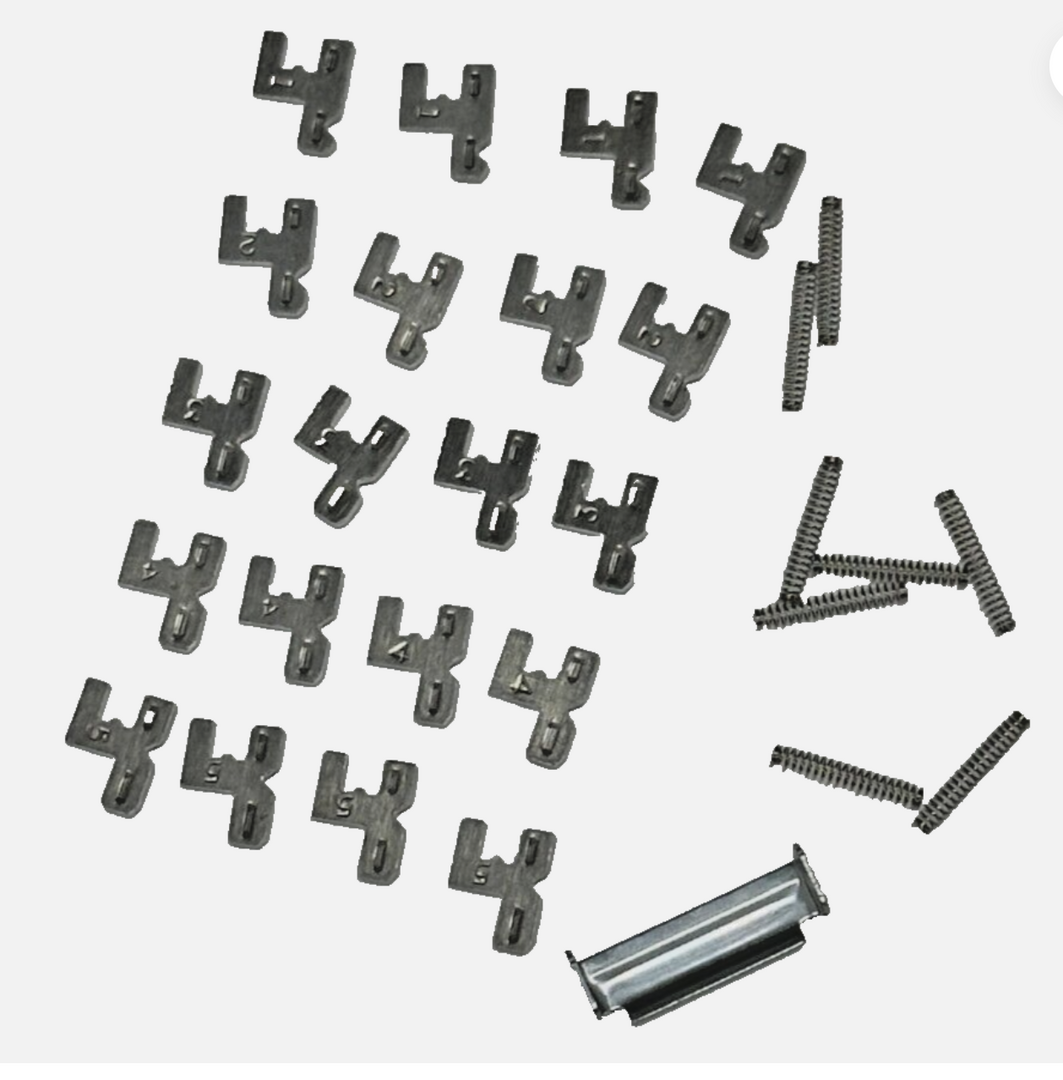
"might" fit due to the following image I found on Ebay:

As can be seen, some of the tumblers look exactly like the ones in the shop manual as below, and even in fact have the "B" stamped in and have the notch in the right location and the right color for a proper "black" tumbler.

Some look almost the same but just without the "tail on the dog", and the color, and with a number stamped in instead of a letter.
And they look like the ones in the first image.
Ole S Olson
Saskatoon, Sask, Canada
1946 DR 3/4 ton stake
1139 old site posts
Also,
it may be possible to figure out the key configuration without taking things apart to find the code on the lock assembly by comparing the old worn key to this diagram from the shop manual:

I have also seen pictures of tumblers with a groove worn deep enough that they would be in the "jiggling the key will open them" category, and a new set of them plus a good key would do the job.
Ole S Olson
Saskatoon, Sask, Canada
1946 DR 3/4 ton stake
1139 old site posts
Thanks for all the responses. I have had the door handles off and sprayed the tumblers with carb cleaner and lubricant. I don't think I have an original key. I had new keys made a couple years ago but I don't think the keys I copied from were original. I talked to a local locksmith but I am not sure he has worked on anything this old. I am going to verify that the kits on ebay are correct and look for another locksmith. I really appreciate the help.
Pete
@william-vance @ole-olson Pete and Ole, I was basing my assertion that those parts are incorrect on the chart at the bottom of the listing. It was listing GM vehicles in the 1990s. I will say again that it is hard for me to believe that worn parts in the lock cylinder are the cause of the problem. This lock has been used only a fraction of the number of times the ignition switch has been used. You say the you have lubricated the lock. Are you talking about the cylinder, where the key goes, or the actual locking mechanism for the door?
Pete, Am I correct that your door lock cylinder is in the push button of the handle? It doesn't really matter, I'm just testing my memory. If you will remove a handle and look for the code, I will make you a key. Let's do that before you spend any more $ at a locksmith shop. If you wind up at the locksmith, he should have the tumblers, or wafers as my lock guy called them. You should not have to buy parts.
Also, I have the name of a locksmith who specializes in this stuff.
Mike
Many Miles of Happy Motoring
3469 Posts on Old VCCA Chat
@35mike The keys that I have are fairly new. I have extra keys and have the same problem with all of them. I lubricated the tumblers and the latch itself. I don't believe it is the latch because the key will not turn at all at times. Once I get the key to turn the lock works fine. I talked to a couple of locksmiths in the area but they don't have the experience with the old stuff. If I can find the correct tumblers it does not that complicated for someone who knows what they are doing. I do not fall in that category.
This is not a major problem but aggravating when I want to lock the car.
Thanks, Pete

Maybe find some help here: https://forums.aaca.org/topic/417718-found-locksmith-for-antique-car-keys/
7046 old site posts
Save a life, adopt a senior shelter pet
There are many good people. If you can't find one, be one.
1938 Master Business Coupe-Sold, now living in New Jersey
1953 210 Sedan
@william-vance Pete, If your new keys were cut from the code found on or near the door lock cylinder, then you can disregard everything I have said. If your new keys were cut on a duplicating key cutter, using your old keys as a pattern, then I would urge you to get the code and send it to me before you do anything else. For $5.00 I will send you a new key. If it works as expected, you can make as many duplicates from it as you want and they should work the same.
Good Luck.
Mike
Many Miles of Happy Motoring
3469 Posts on Old VCCA Chat
There is also this:
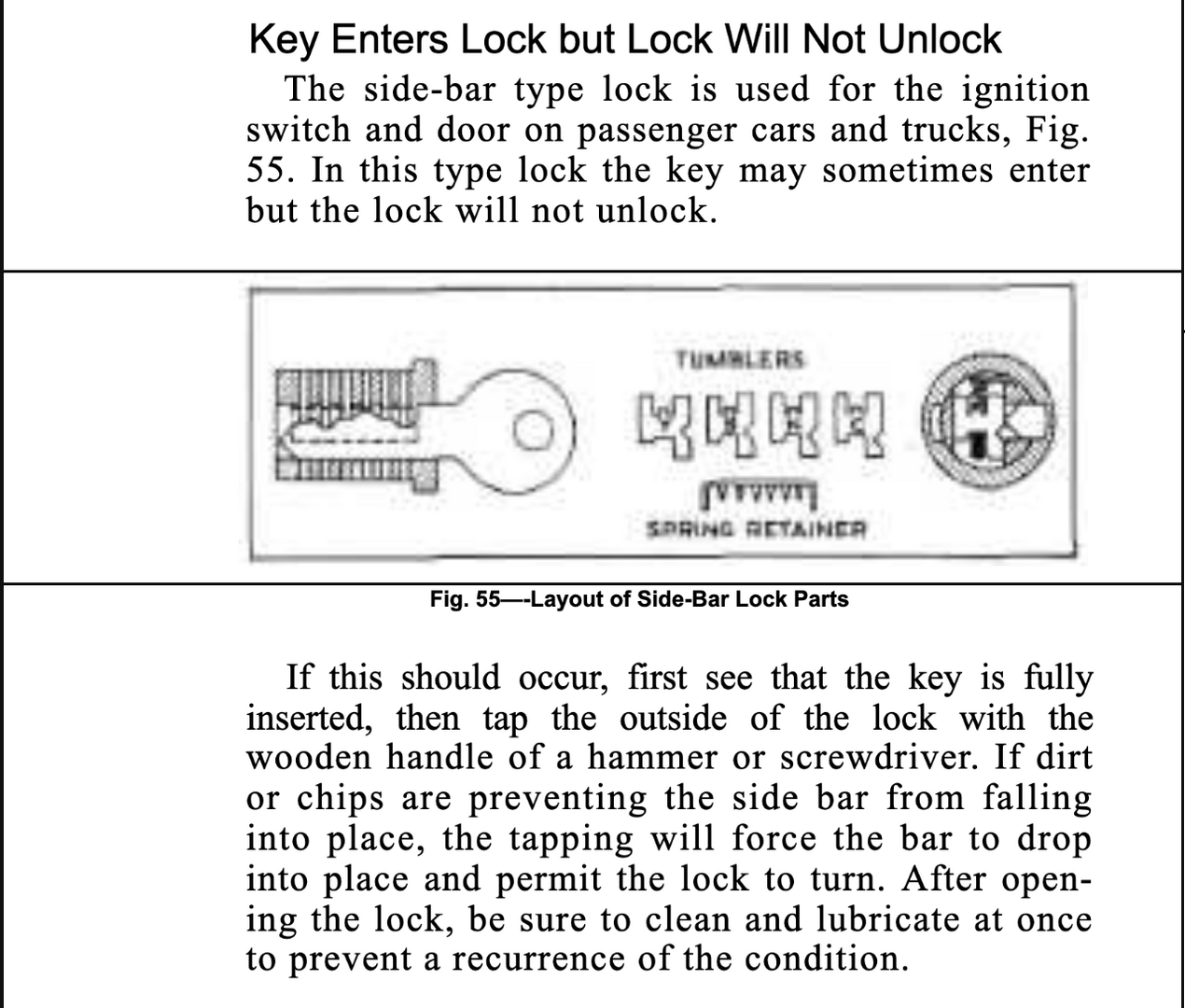
If there is enough grit or whatever in the lock it can prevent the side bar from dropping into the grooves in the tumblers.
This is the old recommendation for overall cleaning in the manual:


I'd try the cleaning procedure first to remove the oil, then the procedure in the first attachment to shake loose any grit.
Then re-lubricate.
As for the graphite, I just use oil as you did and it seems to work fine for me.
Maybe this will do the trick. (fingers crossed) 🙂
Ole S Olson
Saskatoon, Sask, Canada
1946 DR 3/4 ton stake
1139 old site posts