
Reproduction Parts for 1916-1964 Chevrolet Passenger Cars & 1918-1987 Chevrolet & GMC Trucks SHOP ONLINE | ONLINE CATALOG | ABOUT US

I have started the process of removing the clutch on my 36 Master Coupe and have reached the point where I have separated the U-joint. In doing research and reading on this forum, I thought if I were to let the diff hang it would pull the drive shaft back enough to allow me to slide the trans back far enough to get it out. In doing so the opposite happened as the drive shaft moved closer to the trans. After lying under the car and inspecting everything, it appears that I will need to loosen the U-bolts holding the differential to the leaf springs and slide the differential back about 8 inches to remove the transmission. The repair manual doesn't say anything about this. This is my 1st time doing a clutch repair so any and ALL advice would be very much appreciated. I would like to post pics but I haven't posted enough comments yet to be able. As soon as I can I will.
Thank you in advance as I know I will get the help I need.
Jeff Navarro 805-302-7353

Jeff,
Welcome, I don't have a 1936 but several a few years older. If I remember correctly the '36 has an X member of the frame that the torque tube goes through so it is necessary to move the torque tube back to remove the transmission. Removing the U bolts that secure the rear axle saddles on the springs and sliding the rear back on the springs is necessary. That means that the rear of the frame be supported and secured.
How sweet the roar of a Chevy four
Participant on Chatter since 11/22/2001
19758 posts on the former Chatter site
Thanks for the confirmation. I am busy the next 2 weekends, so it will be a bit before I get back at it. I will be posting as I go along in this endeavor to replace the clutch. Always appreciate the direction and help
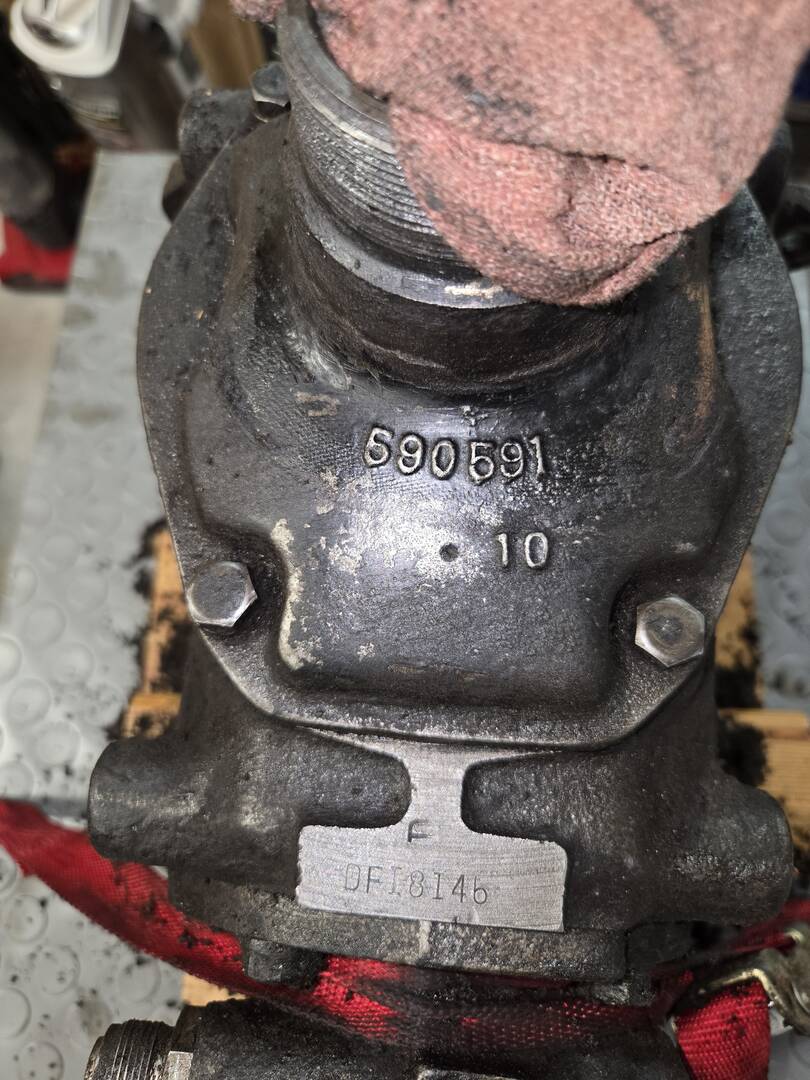
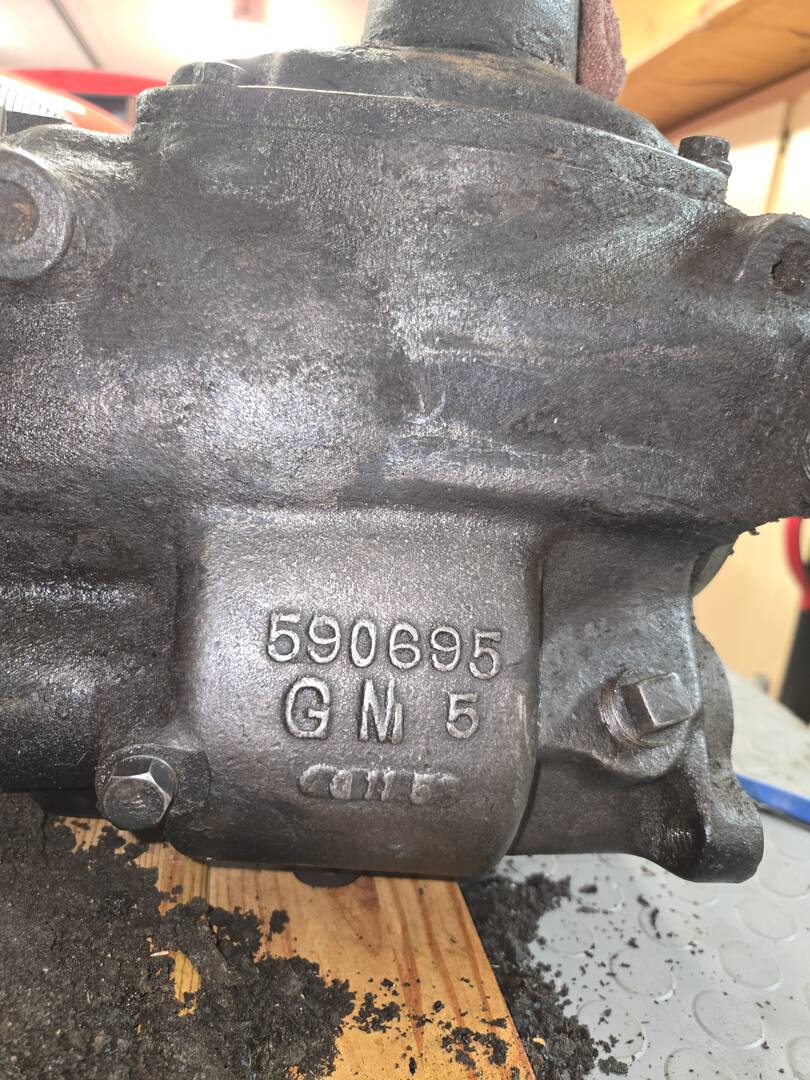
This is the transmission out of the 36 master coupe. Could I have help determining if this is original tranny?
Casting number 590695 is 1934-36 DA EA. Transmission case Part number 590697 is 1934-36 DA, EA, ED, FA, FD (3-Speed). The date code looks like " G 11 5" which translates to July 11, 1935. According to the Master Parts Price List dated April 2, 1945 the 590697 transmission was available for use in 1931-37 and 39- 40 with a few part changes. It is typical for the part number and casting number to be the same or with the last digit 2 or a multiple of 2 numbers different. There are some that have completely different numbers.
How sweet the roar of a Chevy four
Participant on Chatter since 11/22/2001
19758 posts on the former Chatter site


I was pretty sure the front bearing./seal for the drive shaft was leaking. So after draining the heavy tranny oil, I filled it to drive shaft level with 30 weight. And as you can see, the bearing is leaking, does the transmission have to be disassembled to put in new bearings? Probably front and rear.

Many Miles of Happy Motoring
3469 Posts on Old VCCA Chat

I agree.
In fact, I think I'd go as far as to say I'm pretty sure there are no seals there. 🙂
Ole S Olson
Saskatoon, Sask, Canada
1946 DR 3/4 ton stake
1139 old site posts
So then it would be a bad bearing on the front shaft. I have read that the rear bearing allows a little oil to seep through to oil the U joint/drive shaft so the oil comming out the rear of the trans should be ok ? I have never worked on a trans before, so is replacing the bearing something fairly easy or should I find someone in the Phoenix area to do it.
Even with a perfectly good bearing, oil will literally run out of the front if the oil level is at or above the shaft.
It's just the nature of the beast.
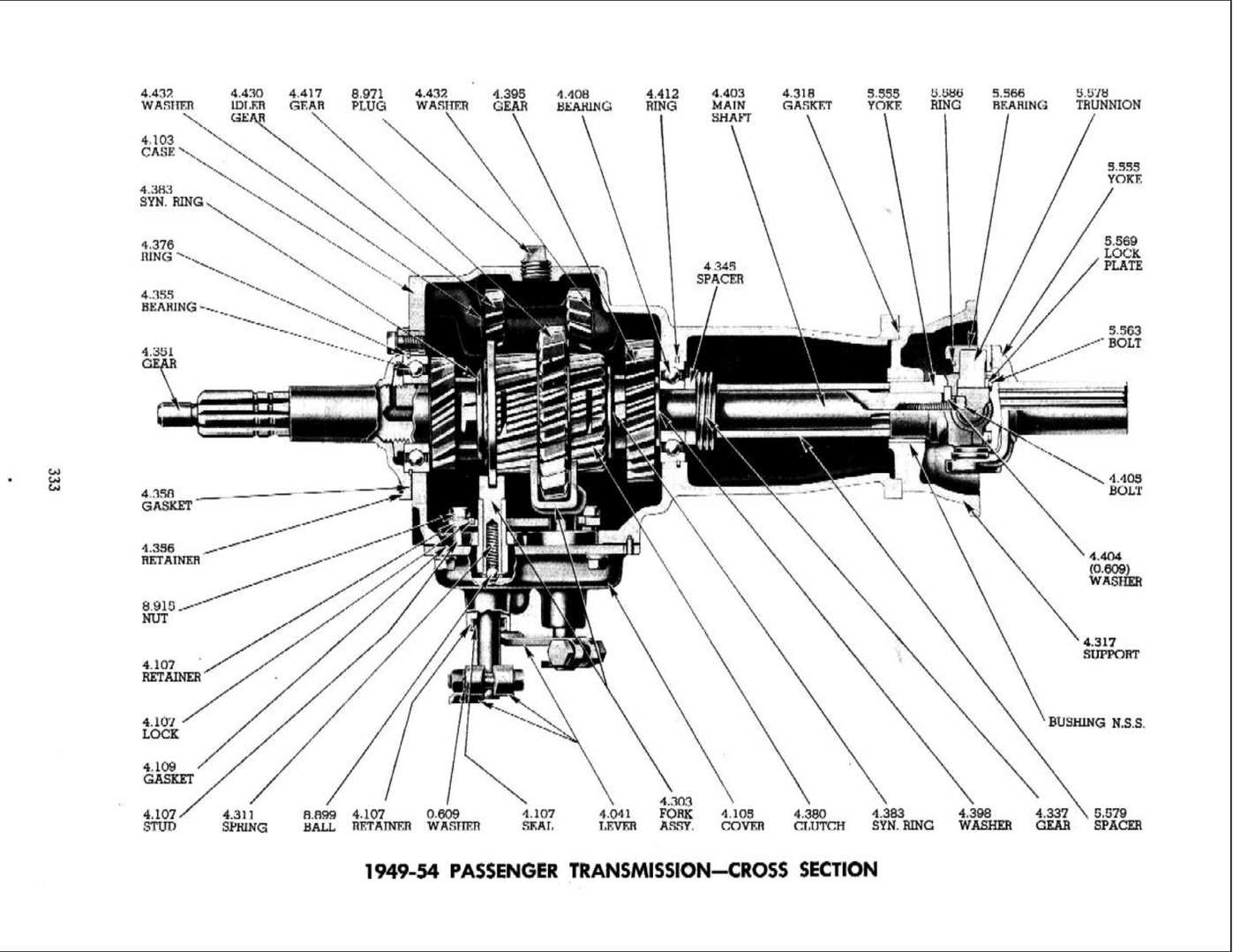
As you can see in the attached cross section, there is no seal.
There is in fact a small gap around the shaft.
The oil that gets past the front bearing is just flung out into a cavity by an oil slinger, and drains back into the case.
Is there something else that makes you think the bearing is bad?
Ole S Olson
Saskatoon, Sask, Canada
1946 DR 3/4 ton stake
1139 old site posts

@jeff-navarro As posted above the oil returns to the case in normal applications. This is usually achieved by a recess in the front cover and an oil slinger on the input shaft . Remove the cover to check for blockage and verify a clean path for the oil to drain is available.Could be as simple as a bad gasket or possibly a bad bearing causing too much clearance .
7472 old site post
Just inexperience with old cars and noticing a little wobble on the drive shaft along with what I thought to be an oil leak due to a bad bearing which I now know to be the norm. I really appreciate the info and direction from all you guys as I work on replacing the clutch on my 36 Master coupe.
I will continue to share pics and no doubt ask more questions as I move forward.
A little wobble to the input shaft is normal, as the shaft only extends a short distance into the transmission to where it rides in a bearing in the output shaft.
That short distance means that even with new bearings there will be "a little wobble".
Unless it seems excessive, it isn't a problem. 🙂
Ole S Olson
Saskatoon, Sask, Canada
1946 DR 3/4 ton stake
1139 old site posts
@jeff-navarro Jeff, You can always come here with your Chevy questions. And sometimes, the answers will be correct.
There was an aftermarket "Okie Bushing" for the front of your driveshaft tube, that incorporated an actual seal. These might be available at The Filling Station.
Mike
Many Miles of Happy Motoring
3469 Posts on Old VCCA Chat