Reproduction Parts for 1916-1964 Chevrolet Passenger Cars & 1918-1987 Chevrolet & GMC Trucks SHOP ONLINE | ONLINE CATALOG | ABOUT US

Love driving my 40, but crazy traffic argues for going with disc brakes. Would welcome advice from others who have made this change on any tips, problems to lookout for and recommendations on sources for parts kit. My usual sources, Filling Station, Chevs of 40s don't have kits for my vehicle available. Thanks for any advice and guidance. Will also change to dual reservoir master cylinder and wonder about any suggestions on adding brake fluid given original filling through floor pan.

@robert-bonnaffon Robert, Speedway motors might have a kit for your conversion. They could possibly have one which would allow you to retain your 6 bolt wheels. There are many compact, under floor, power bake setups with the dual master cylinder. Speedway will have these too.
All that being said, I am surprised that your brakes are not adequate. I have a 1935 Chevy with mechanical brakes and a 1936 Chevy 1-1/2 ton truck with original hydraulic brakes. When properly adjusted, they do their job well.
The changeover will be a lot of work to do a tidy job and perhaps a bit expensive, as well. If you have not already done so, I would make sure your original brakes were performing at maximum effectiveness before making any changes.
Mike
Many Miles of Happy Motoring
3469 Posts on Old VCCA Chat
Mike, thanks much for lead for Speedway Motors. I do hear you on functioning on adequate functioning of original drum brakes, and on costs of conversion. I do feel as though the disc brakes would provide a significant improvement, but it certainly food for thought especially once I understand the full price tag. I hope to get input from members who have gone through the conversion on their cars to see if they what they thought about brake performance and the conversion process. Thanks again for your thoughts, Bob

Hi Robert
I agree with Mike regarding your original brakes.
In this day of power everything, people have gotten used to not having to apply much force to anything.
Original brakes may seem to be a little anemic, but If you really stand on them, there is more there than most people realize.
I thought the brakes on my '46 3/4 ton were maybe a little weaker than they could be too, and have always left a little extra room in front of me for that reason.
But, a couple months back, just as I was swinging into a right hand turn, someone standing on the sidewalk at the corner suddenly turned completely around and stepped off onto the street.
I've driven a lot of vehicles without power brakes, and instinct kicked in and I hit the brakes hard.
I was actually a little surprised when my front tires actually howled to a stop.
As Mike said, if the original brakes are in the condition they were originally meant to be, they are much better than most people think.
Ole S Olson
Saskatoon, Sask, Canada
1946 DR 3/4 ton stake
1139 old site posts

You might find using later drum brakes might help without doing much work

We have members in our Region who take new Huck brake shoes and existing drums to the local heavy duty truck brake shop. The shop relines the shoes with a higher friction material and then arcs the shoes to fit the drums. The change in stopping performance is dramatic.
@michael-falise @robert-bonnaffon
Agreed!
Grinding the arc alone will make a huge difference.
It isn't often done, but is/was a critical part of a really good brake job.
Great suggestion.
Ole S Olson
Saskatoon, Sask, Canada
1946 DR 3/4 ton stake
1139 old site posts
All comments much appreciated. Thus far I have been unable to find a disc brake conversion kit to fit my vehicle, after checking with Chevs of the 40s, Filling Station, Classic Performance Products, ECI Engineering Components and ABS Power Brakes Inc. There are kits to fit 40s with straight axels but not knee action with original 16" 6 lug wheels, which I would like to keep. So, the thought of improving existing drum brakes with higher friction material is really interesting. I wonder how using higher friction material would impact wear on the drums? Is it necessary to start with new brake shoes as opposed to using existing shoes? Can replacing friction linings be done if existing shoe linings are either bonded or riveted? What is done in the process of "arcing the shoes", I'm not familiar with that process at all. With the linings, is there a specific material that is recommended and/or a friction performance grade that is recommended, considering what might be the best match for our drums? BTW, I also plan to look for a dual reservoir master cylinder so if that is recommended with harder friction material, that wouldn't be a concern....if I can find one that fits on my convertible's frame. Again, thanks for all advice on this, Bob
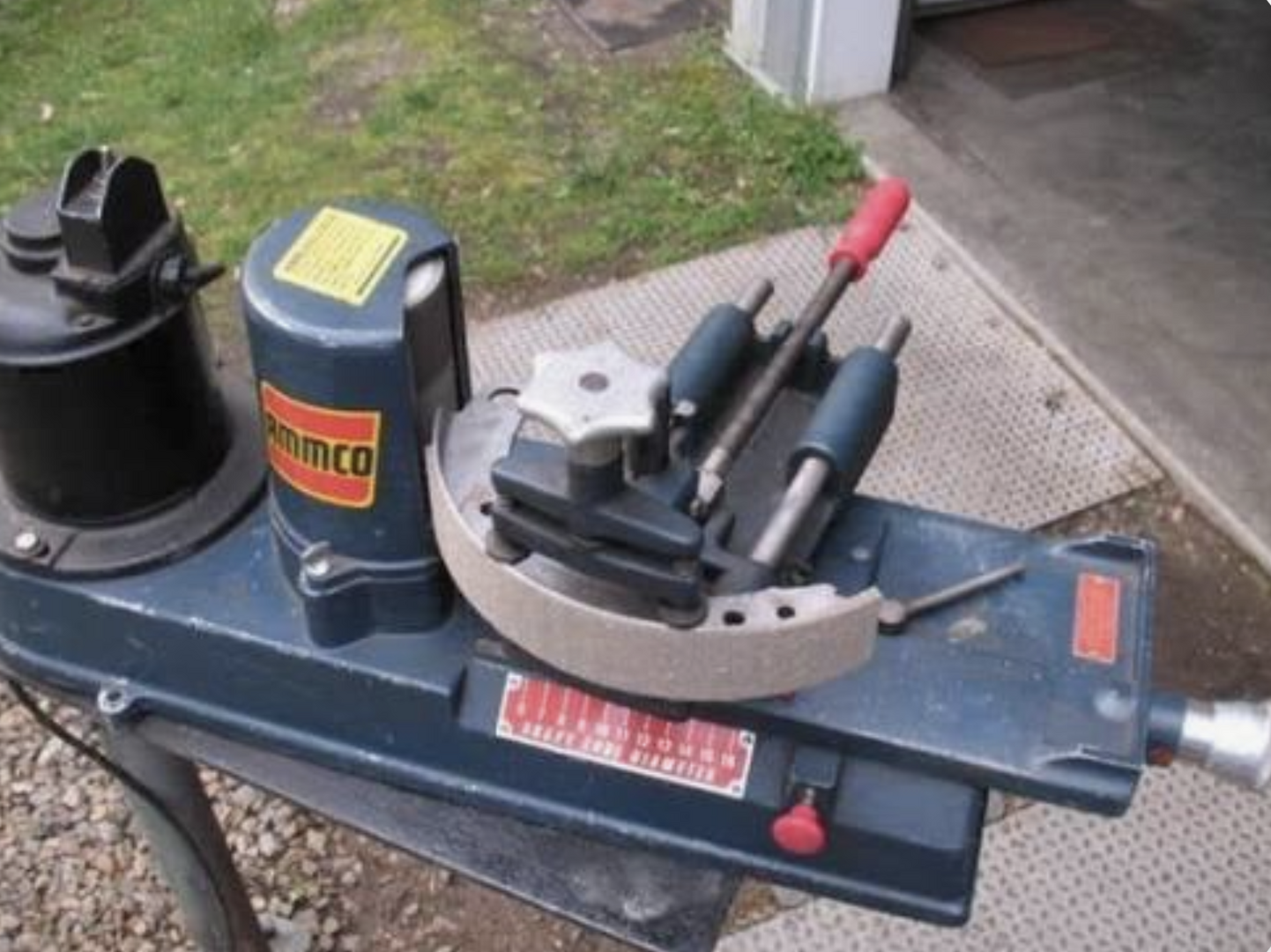
Arc grinding is done to match the radius of the brake shoe exactly to the radius of the brake drum it contacts.
This insures full contact of the shoe on the drum along the entire length of the shoe, which is of course important, especially if the drums have been reconditioned.
Ole S Olson
Saskatoon, Sask, Canada
1946 DR 3/4 ton stake
1139 old site posts
I’d try to find a local brake service shop that specializes in heavy duty trucks and construction equipment and ask if they would be willing to reline and arc automotive shoes. They should be able to recommend a lining material that will provide more stopping power without significantly compromising longevity. I’m guessing the question about new or old shoes depends on the condition of yours when they see them.
@robert-bonnaffon @michael-falise @ole-olson You guys might already know this. The friction materials being used nowadays is not as effective as the old linings before asbestos was banned. An "old stock" set of shoes or linings might give some improvement in braking.
Mike
Many Miles of Happy Motoring
3469 Posts on Old VCCA Chat
Now understand the arc grinding process and also will look into heavy truck brake shops and see what I can find out. Different subject, do you all have any thoughts on how I might add modern tube type shocks to my vehicle and/or where would be best to post the question on our forums?

While you may be able to improve the mechanics of the brake system once the brake locks up it is the tire contact on the road that will mostly determine how well the car stops. i have newer type non asbestos aggressive lining on my 32 and locking the brakes is not a problem-but the skinny tires do not put a lot of rubber on the road. I do think that the wider tires would help but when do you stop "upgrading" and still have an antique car?
7472 old site post

I don't know if it became standard on straight axle cars but Chevy started offering tube shocks in 1939. I used '39 brackets to convert my 38 to tube shocks. I would assume they would be available in 1940.
7046 old site posts
Save a life, adopt a senior shelter pet
There are many good people. If you can't find one, be one.
1938 Master Business Coupe-Sold, now living in New Jersey
1953 210 Sedan