
Reproduction Parts for 1916-1964 Chevrolet Passenger Cars & 1918-1987 Chevrolet & GMC Trucks SHOP ONLINE | ONLINE CATALOG | ABOUT US

had to learn to double clutch

Welcome to the website, Dave!
When the engine was rebuilt, how well did they clean out the water jackets in the engine block and the head? A lot of rust and crud builds up in there, especially around cylinders 3 and 4 because water does not flow back there very well.
One thing you could do, which is not too invasive, is to take off the head and inspect the water jackets through the holes where the water flows from the block to the head. If there is junk in there, you can loosen it with a coat hanger wire or a screwdriver and vacuum it all out.
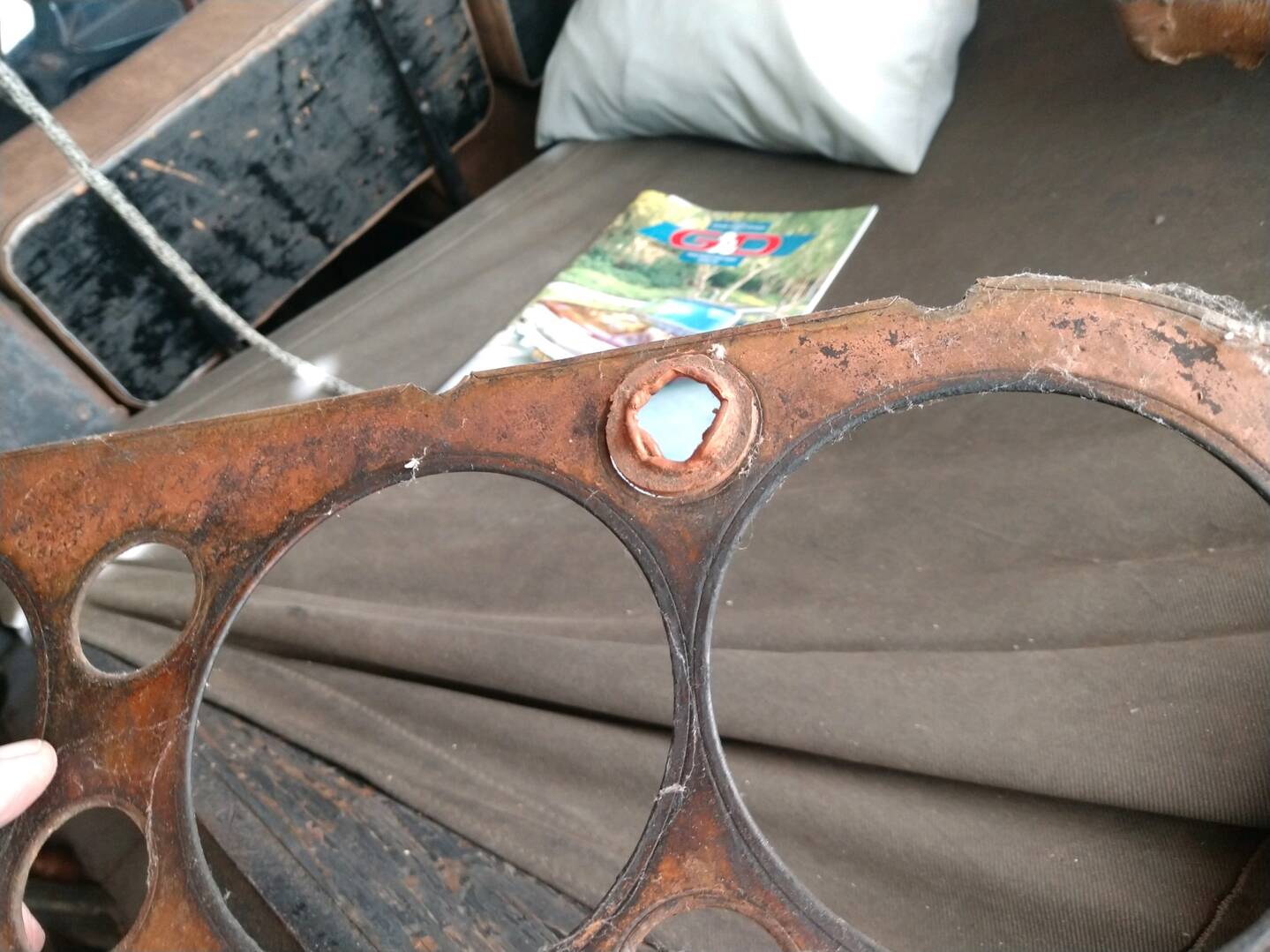
Another thing you can inspect with the head off is to see if the engine rebuilder put sealant around the water holes when reassembling the engine. I ran into this situation with my '28 Canopy Express. The previous owner had engine work done, but reassembled it himself. Unfortunately, in quite a few cases he didn't know what he was doing. One of the mistakes he made was putting silicone sealer between the head and the block, resulting in almost completely clogging up the water holes through which the water flows from the block to the head. See the attached photo of one of the clogged holes. All of them looked like that!
Keep us posted on what you find and how you fixed the overheating problem.
Cheers, Dean
Dean "Rustoholic" Meltz
San Leandro, CA
3511 posts on vccachat.org
Lurch -1927 LM one ton truck - tinyurl.com/Lurch-VCCACHAT-Gallery
Justin - 1928 AB Canopy Express (1/2 ton truck) - tinyurl.com/Justin-Stovebolt-Gallery
Thanks, water is running clear but I'm going to pull the head, they said the block was boiled, also the water pump is pumping but not sure how much I should see moving, i've heard there should be a restrictor in the radiator hose, some say yes, some say no, would this be in the engine where the water flows? Thanks

Hi Dave
It is physically impossible to make an engine run cooler by restricting the coolant flow.
And when I say "physically", I literally mean basic physics makes it impossible.
It's all about heat transfer from the coolant through the radiator fins to the air.
The rate of heat transfer depends on the difference in temperature between the coolant and the air.
The greater the difference, the faster the heat transfer.
If you slow down the flow, the coolant is in the radiator for a longer time, so it's actually cooler when it gets to the bottom of the radiator.
Because of this, the bottom part of the radiator is radiating heat at a SLOWER rate than it otherwise would.
So, to attain the same overall amount of heat being transferred out of the entire radiator, the coolant has to go into the top of the radiator (and therefore out of the engine) HOTTER.
And, my personal experience with a flat head ford and a gasoline powered combine engine verify that. Engines run cooler with the thermostat removed.
Hope that helps. 🙂
PS
I just had coffee with a mechanical engineer versed in thermodynamics and heat transfer. (He's my son 🙂)
He confirmed the principles above and affirmed that all other things being equal, reducing coolant flow can not possibly make an engine run cooler.
Ole S Olson
Saskatoon, Sask, Canada
1946 DR 3/4 ton stake
1139 old site posts

Having worked in automotive coolant research for one of the world's largest coolant manufacturers, I can verify the basic information in the Stovblt post. Unfortunately people rely on coolant temperature under the assumption that the lower the temperature the better for the engine. That is typically just the opposite. Hotter engines generally are more efficient (use more of the BTUs to move the tires). As long as the metal does not reach or exceed damaging temperatures all should be good.
How sweet the roar of a Chevy four
Participant on Chatter since 11/22/2001
19758 posts on the former Chatter site