
Reproduction Parts for 1916-1964 Chevrolet Passenger Cars & 1918-1987 Chevrolet & GMC Trucks SHOP ONLINE | ONLINE CATALOG | ABOUT US

I am preparing to swap out the 4.11:1 original rear end for a new 3.55:1 unit in my 1945 Civilian 1/2 Ton. I read that shims are used to adjust the ring-and-pinion gear mesh. Steve, the owner of the Filling Station, told me those shims are determined at the factory, related to inconsistencies in the torque tube and other parts of the assembly, and to re-use those shims. It seems there is ample chance for further inconsistencies to develop over time, so a guy should have a shim set on hand. I have a choice between an assembly kit with a shim set or, for the same price, an assembly kit with wheel bearings and seals instead. Any advice, guys?

Hey there, good to see you back!
Just for clarity, are you saying the assembly kits consist of a ring gear, a pinion and shaft, and either a shim pack OR wheel bearings and seals?
If so, take the shim pack.
Wheel bearings and seals are easily found else where if you need them.
That said, are you sure you want to do this?
Setting for proper mesh on a ring and pinion isn't real easy, and I've even seen journeyman mechanics do a bad job of it.
Ole S Olson
Saskatoon, Sask, Canada
1946 DR 3/4 ton stake
1139 old site posts
I was hoping to hear from you, Ole. The Ring and pinion come as a set. The Assembly Kits are separate, and different suppliers put different stuff in their A. Kits. You can tell from my post, I'm concerned about getting the ring and pinion to mesh just right. What is the tricky part?
Yes, a major desire is to drive "Vicky The Truck" on some day trips involving highways. I'm justifying the gear change as preventative medicine. For instance, she already burns some oil. I'd like to relax my jaw at 55 mph. Besides, she has some go-fast paint on her front end now. (Interesting, in this version of the photo, the Civilian wartime Turret Grey looks a lot like chrome! The only chrome is in the headlight bulbs.)
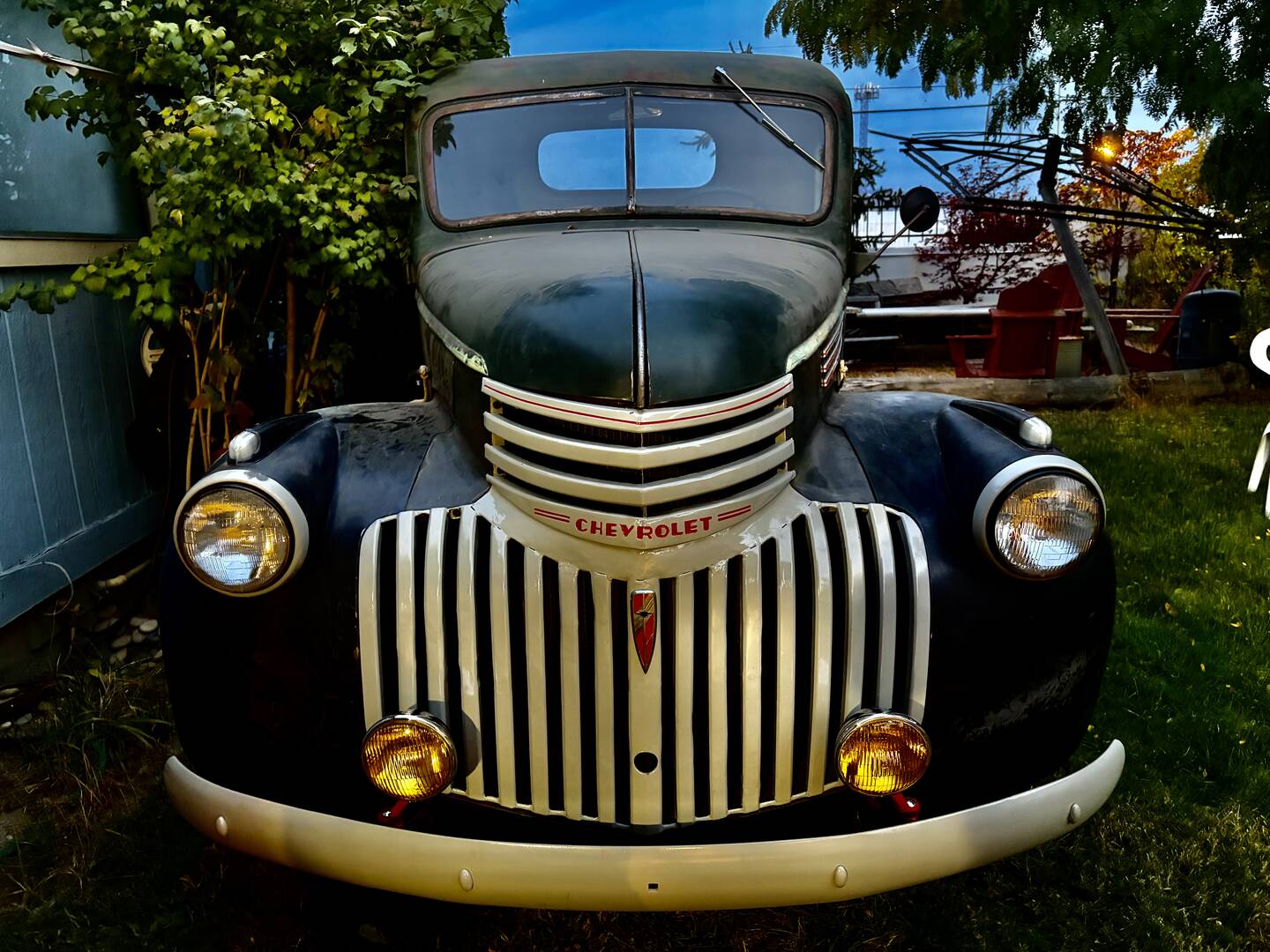
Jake and Vicky
There are essentially 2 adjustments that effect 3 critical dimensions and all have to be right and all depend on or are affected by one another.
The pinion depth (the distance the pinion is from the axle center line) has to be right to attain the right tooth contact pattern and is the one adjusted with the shims.
The ring gear has to be the right distance left or right to again attain the right tooth contact, while at the same time attaining the right backlash between the ring and pinion.
If your pattern check with prussian blue after assembly reveals that the pinion is too deep (too far back) or too shallow (too far forward), it means completely disassembling the whole thing so you can add or deduct shims.
It's been some time, but ring and pinion sets used to have a number stamped on them to tell you the "nominal" shim pack thickness to start with and were either right or very close.
You will need to know how to "read" the pattern in the prussian blue when checking and know how to correct any deficiencies, but that information with good pictures should be available on the internet or in a good service manual.
An improper tooth contact pattern will result in a noisy rear end and a short gear set life.
All this is doable, just be aware of what you are getting into before you do it.
FWIW, I'm running 7.00R15 tires with a 4.57 axle on my '46 and it turns a bit above 2700 RPM at 50 mph (which it does quite regularly).
With the 4.11, you should be turning about 2550 at 50 mph and about 2800 at 55.
That's not horribly fast, and the 292 in our old grain truck has put on a lot of miles running faster than that when heading back empty. 🙂
Ole S Olson
Saskatoon, Sask, Canada
1946 DR 3/4 ton stake
1139 old site posts

Are you swapping out the entire rear end or are you changing the R&P gear set?? I believe if changing just the gear set with OEM parts the differential case needs to be replaced. I swapped out the gear set in my 51 from 4:11 to 3:55 and did change the differential case. There is about 100 thousandths difference in the case thickness where the ring gear mounts and not enough adjustment in the case side bearings to properly center the ring gear. I am not positive this applies to the 45 but you might want to check it .
7472 old site post
Thank you Ole!
I printed your instructions & attached them to the instructions below. There were several references to the instructions below in my research. If you feel like it, could you review these instructions for weak points?
https://www.stovebolt.com/techtips/axles/355%20gear%20swap/
Thanks Ole,
Jake
Thanks Steve,
Your key phrase is "changing just the gear set with OEM parts. It makes sense; back in the day, Chev put "higher" ratio pumpkins in cars. They were in the neighborhood of 3.70:1. These assemblies are indeed larger than the reproduction version, so use of OEM components requires the OEM "differential case" you speak of.
The current reproduction R&P Set is modified to fit into the stock 4.11:1 differential case. Probably near 100% of new 3.55:1 R&P sets are intended to replace the stock 4.11:1 assembly, so they make it "Plug & Play."
Are you pleased with your conversion? Is it quiet?
Jake
I have yet to get the car on the road but have no doubts that the 3:55 will be good. My car is a 12 year total restoration project that has been a real challenge . I just recently got the rebuilt engine running and have yet to take it down the road.
7472 old site post
I'm not sure what to tell you about the instructions you linked to.
They seem to be a little thin on details in some places, and contradict the information in Chevrolet Shop Manual in others.
For example, they say to save the pinion shaft shim, clean it up, and "add" shims from the kit to get a total thickness of .026" to .028", when the Shop Manual says the original shims will already be .030" to .036" thick and you should start with .033" when installing a new gear set.
Maybe some of the dimensions around the shim shoulder on the new pinion shaft are different?
Also, they show the backlash as .008" to .012", and .012" seems like a lot to me, especially when the Chevrolet spec was .005" to .007".
Backlash will however be dictated by and should be supplied by the manufacturer of the gear set.
What ever the manufacturer says should be followed, and disregard what is quoted in the instructions you linked to.
The Chevrolet information can be found here:
https://chevy.oldcarmanualproject.com/shop/1942/42csm0401.htm
and I'd be inclined to put more trust in that source.
PS
The Chevrolet instructions don't mention checking the pattern with prussian blue, but I think that they treated that as a given that every good mechanic would know and perform.
That's why they said to start at a shim thickness of .033", while stating that the thickness found on disassembly could be anywhere from .030" to .036".
The instructions you linked to say to do the check, but say to look at an above picture to see what a good pattern looks like.
On my screen, the picture is so poor, I can't see anything worth looking at.
Decent pictures and what to do to correct a poor pattern can be found elsewhere on the internet.
Ole S Olson
Saskatoon, Sask, Canada
1946 DR 3/4 ton stake
1139 old site posts
Thanks Ole for all that excellent info. I'm now starting to wonder if the tricky adjustment parts of this job could be done my myself on my bench at home. Since The Shop is going to put Vicky up in a lift in back during their upcoming slow period for fill-in work, she will be up in the air for a matter of days. If they will allow it, do you think my DIY idea would work? I had these 2 Techs do some clutch work on Vicky last winter & I had to take it back. They are used to production work.
The Filling Station guy thinks the R&P gears are made in Taiwan. I guess that's the best that can be hoped for. I asked if they have ever had any problems with them. He said they have sold 10 so far this year with no problems. Interestingly, they do not provide any instructions.
'Jake'